XDel Technology Enables Sustained Protein Depletion and Simplified Genotyping Compared with Conventional CRISPR Guide Designs
Key Takeaways
- XDel maintained robust protein depletion across four membrane targets in K562 cells, with depletion sustained for up to 3 weeks post-transfection.
- NGS genotyping revealed stable large-fragment deletion profiles across multiple passages, with robust protein depletion maintained despite a high proportion of in-frame deletions.
- Compared with single-guide and two-guide CRISPR approaches, XDel achieved greater knockout performance, including 95% CD46 protein depletion versus 70% for a two-guide competitor combination (p < 0.05), while generating larger targeted deletions.
- XDel simplifies genotyping by requiring only one primer pair for Sanger or NGS sequencing, reducing time, cost, and workflow complexity compared with conventional two-guide approaches.
- Single-vial delivery streamlines workflow by eliminating guide resuspension, normalization, and guide-mixing steps required for conventional multi-guide designs.
Background
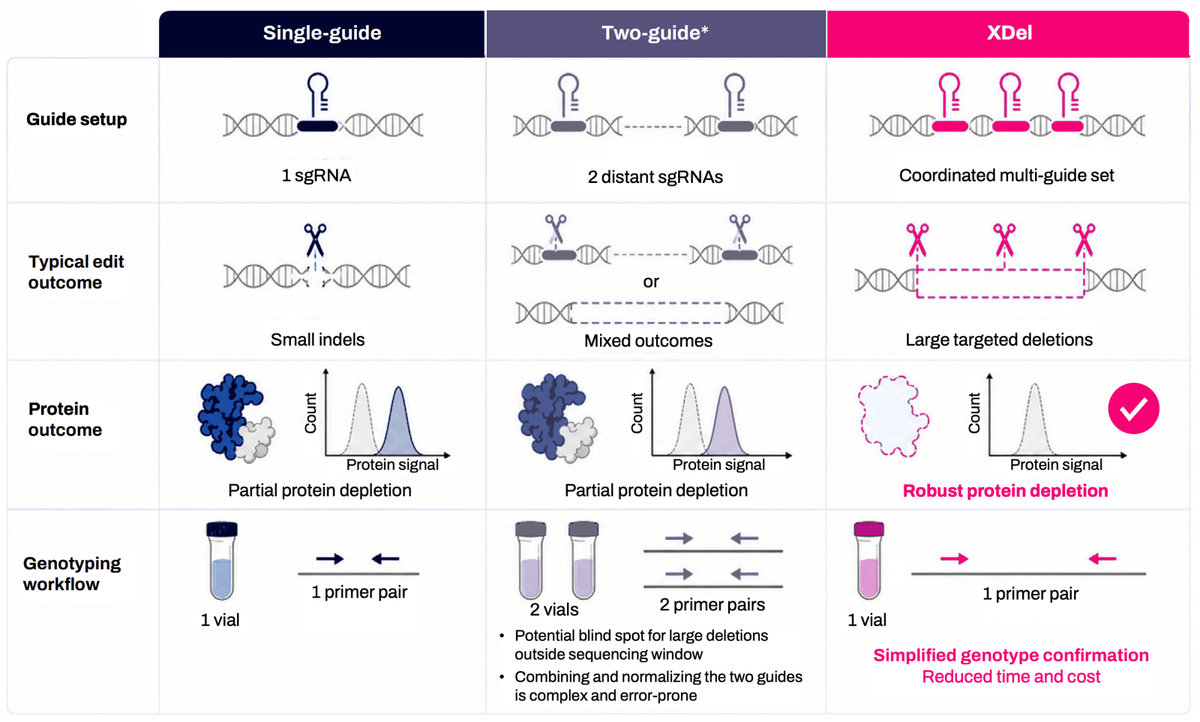
Many commercial CRISPR-based editing systems use one to two guide RNAs to disrupt protein expression by generating insertions and deletions (indels) that shift the protein reading frame. However, DNA repair mechanisms can sometimes generate in-frame deletions — whose lengths are multiples of three nucleotides — that remove amino acids without disrupting the reading frame, potentially leaving the protein partially or fully functional.
When gene editing fails to completely eliminate target protein expression, confidence in the interpretation of downstream phenotypes diminishes.
EditCo’s XDel technology is designed to address this by generating larger deletions that result in high, sustained protein depletion. XDel uses up to three modified sgRNAs positioned close together within a single early exon, working cooperatively to create large, targeted fragment deletions of 21+ bp.

Experimental design
Four surface membrane proteins — CD46, CD55, CD59, and CD82 — were knocked out in human immortalized K562 cells using XDel designs. Transfection was performed in duplicate (n = 2), with each biological replicate split into 3 technical replicates post-transfection (n = 6).

- Protein expression measured by flow cytometry at days 3, 7, 14, and 21 post-electroporation
- Editing efficiency quantified by NGS using EditCo’s Eos NGS Library Preparation workcell and proprietary NGS analysis tool
- Cell viability measured using viability dye DRAQ7
Results
Sustained protein depletion across four targets
Flow cytometry revealed greater than 90% protein depletion across all four membrane targets at all time points, persisting for up to 3 weeks post-transfection. Cell viability remained high throughout. Tight error bars across replicates confirm high reproducibility of the XDel approach.
Stable indel profiles by NGS
NGS genotyping of CD55 and CD59 knockouts showed observed indel lengths of ≥54 bp — consistent with large fragment deletions expected from XDel’s multi-guide strategy. The proportion of individual indels remained stable across multiple cell passages. Notably, despite a high proportion of in-frame deletions, complete loss of detectable protein expression was observed and persisted over time — suggesting large in-frame fragment deletions through XDel’s multi-guide strategy are sufficient to cause sustained protein depletion.
XDel vs. single-guide: higher efficiency, larger deletions
Editing efficiency of CD46-targeted XDel guides was compared with individual Vendor X sgRNAs:
- XDel: complete loss of detectable CD46 protein, fragment deletions ≥36 bp
- Vendor X sgRNA 1 and 2: only partial CD46 protein loss, low editing efficiency, indels ≤18 bp
XDel generated a higher proportion of in-frame deletions than the single guides, yet still achieved complete protein loss — confirming that deletion size is a critical determinant of functional knockout outcomes.
XDel vs. two-guide: 95% vs. 70% protein depletion
The two-guide combination's distant guide placement requires two primer pairs and separate sequencing reactions — and creates a potential blind spot for fragment deletions outside the sequencing window of either primer pair. XDel’s compact guide positioning eliminates this risk.
| XDel | Vendor X two-guide combo | |
|---|---|---|
| CD46 protein depletion | 95% | Up to 70% (*p < 0.05) |
| KO score by NGS | Significantly higher (***p < 0.001) | Lower |
| Fragment deletion size | ≥107 bp | Small |
| Guide vials | 1 | 2 |
| Primer pairs for genotyping | 1 | 2 |
| Sequencing reactions | 1 | 2 |
Conclusion
XDel technology generated large-fragment deletions associated with sustained loss of detectable protein expression across multiple targets in human K562 cells. Compared with Vendor X single guides or a two-guide combination, XDel produced larger fragment deletions resulting in complete loss of protein expression, and required only a single NGS primer pair and sequencing reaction for genotyping confirmation.
These results demonstrate that XDel provides a streamlined and effective CRISPR knockout strategy for applications such as antibody validation that require a clear linkage between genotype and protein-level loss of function.
Ready to run XDel in your experiment?
Authors
- Cac Tran
- Laura Donohue
- Montse Morell
EditCo Bio · Jun 2026
Download Full application note (PDF)
Includes all figures, NGS data, flow cytometry time-course, and statistical analysis.
Resources

The Editorial
Single Guide vs Two Guide vs XDel: Which CRISPR Knockout Strategy Is Right for Your Experiment?
Explore a side-by-side comparison of single-guide, two-guide, and XDel approaches, including when each is best suited, the supporting data, and key considerations for your experiment.
Read More
XDel Case Study
Unveiling SURF2’s Role in Nucleolar Stress and Its Potential as a Therapeutic Target
Discover how EditCo’s XDel Knockout Cells helped researchers at Université de Toulouse accelerate cancer research by targeting SURF2. Download the case study.
Read More
XDel Application Note
XDel technology maximizes on-target editing and minimizes off-target effects
Learn how EditCo’s XDel CRISPR technology enables efficient, high-fidelity gene knockouts with minimal off-target effects across all cell types.
Read More
The Editorial
How to Choose the Right Knockout Kit
EditCo’s XDel gene knockout kits ensure efficient, reliable CRISPR knockouts, perfect for research and high-throughput workflows.
Read More
The Editorial
Introducing Cell Editing with XDel CRISPR Technology
Efficiency, reproducibility, & simplicity—EditCo brings its extensive CRISPR expertise to XDel Knockout Cell Pools & Clones in immortalized & iPS cells.
Read More