Compare single-guide, two-guide, and coordinated multi-guide CRISPR knockout strategies to understand how guide design affects protein depletion, genotyping, and experimental success.
Designing a CRISPR knockout experiment often seems straightforward: select a guide RNA, deliver the edit, and validate the outcome.
In practice, however, the guide strategy has a major impact on experimental success. It influences editing efficiency, the types of mutations that are generated, the complexity of genotyping, and ultimately whether protein function is effectively disrupted.
At EditCo, we've performed hundreds of thousands of CRISPR edits, and one pattern is consistent: achieving sustained protein depletion is often more challenging than expected. The guide design is frequently one of the biggest factors determining knockout performance.
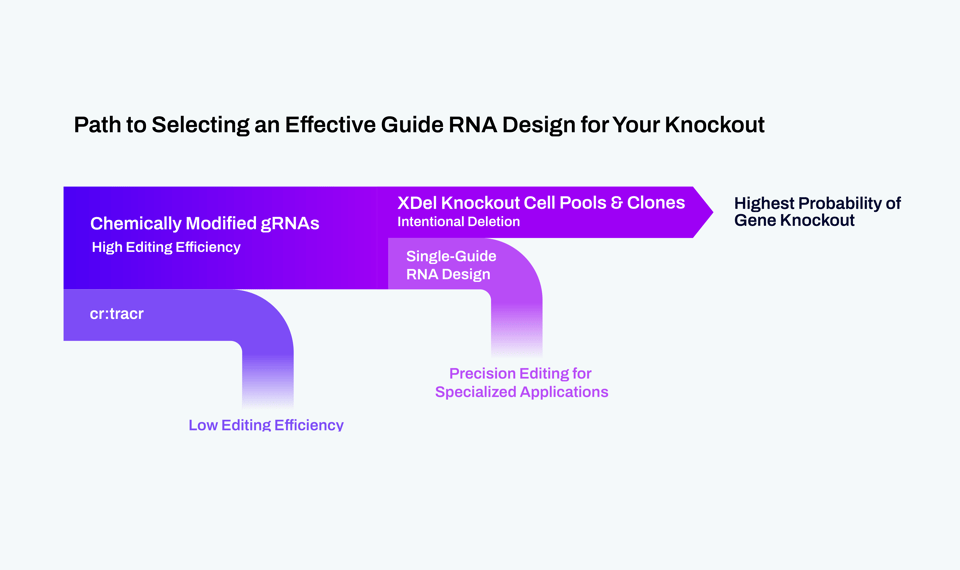
Most researchers choose between single-guide and two-guide knockout approaches. While both are widely used, each has important limitations. Coordinated multi-guide strategies such as XDel were developed to generate larger targeted deletions while simplifying both transfection setup and genotype confirmation.
So how do these approaches compare, and when should each be used?
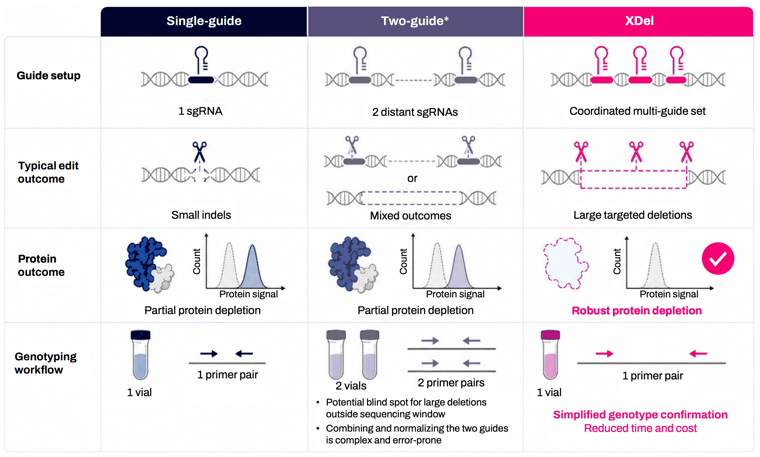 Figure 1. XDel enables sustained protein depletion with a simplified genotyping workflow. High-level comparison of the advantages of the XDel approach versus conventional single-guide and two-guide CRISPR knockouts. *Note: Adding a third guide would increase workflow complexity further by introducing another vial that must be combined and normalized and would require a third primer pair and sequencing reaction.
Key Takeaways
-
XDel induced and maintained robust protein depletion across four membrane targets in human immortalized cells, with depletion sustained for 3 weeks post-transfection.
-
NGS genotyping revealed stable indel profiles across multiple passages, with high protein depletion maintained despite the presence of in-frame deletions.
-
Compared with single-guide and two-guide approaches, XDel led to greater protein depletion and larger fragment-deletion profiles while reducing setup complexity through its single-vial delivery.
-
XDel simplifies genotype confirmation by using a coordinated guide set in proximity, enabling NGS or Sanger genotyping with a single primer pair. Two-guide approaches with distant target sites require multiple primer pairs and sequencing reactions.
-
XDel is a high-quality, easy-to-use solution for reliable, reproducible CRISPR experiments.
Single-Guide Knockouts and Partial Protein Loss
A single guide RNA creates one cut. The cell repairs it, usually leaving a small insertion or deletion. That sounds like a knockout — but small edits are frequently in-frame, meaning the protein is still produced. The result: partial expression that confounds downstream assays.
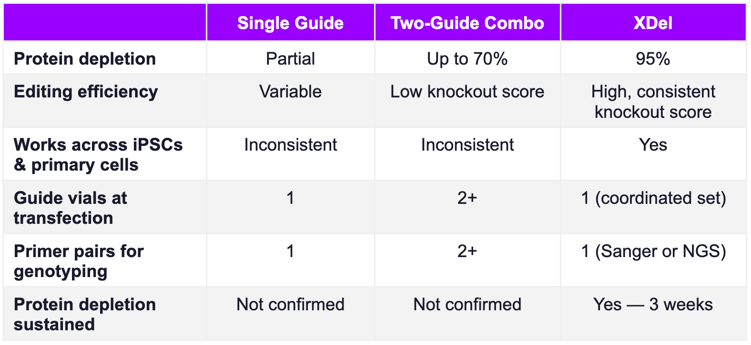
In our head-to-head data, single-guide designs produced only partial protein loss — even using guides from an established vendor. XDel achieved high, sustained protein depletion in the same experiment.
Two-Guide Knockouts Add Complexity Without Guaranteeing Full Depletion
Adding a second guide helps — but the standard approach places guides far apart. That means multiple vials to manage, multiple primer pairs for genotyping, and additional time and cost at every step.
In a direct comparison targeting CD46, a two-guide competitor combination achieved up to 70% protein depletion. XDel achieved 95% in the same experiment — and the gap in knockout score, confirmed by NGS, was even larger.
XDel: Coordinated Multi-Guide Knockouts for Reliable Protein Loss
XDel places up to three modified sgRNAs within a single early exon. They work together — not independently — to create large, coordinated deletions that reliably disrupt protein function.
The result is a fundamentally different class of edit: one that achieves sustained protein depletion regardless of reading frame, holds up across passages, and confirms cleanly with a single primer pair — for either Sanger or NGS sequencing.
Choosing the Right CRISPR Knockout Strategy
Gene Knockout Kits
Best for single-gene knockouts. Order online, delivered in 5 days. Includes modified sgRNAs, ICE primer sequences, and QC documentation.
Arrayed gRNA Libraries
Best for pathway or genome-wide screens. Pre-plated in 96- or 384-well format. 30+ pathway options or 20,000+ gene whole-genome coverage. Libraries ship in as fast as 7 days.
XDel Knockout Cell Pools and Clones
Best when you need ready-to-use edited cells. EditCo handles everything from guide design to QC-verified delivery. Works across immortalized cells, iPSCs, T cells, and fibroblasts. Pools in ~4 weeks, clones in ~10 weeks.
The Bottom Line: More Reliable Protein Depletion with XDel
Guide coordination—not just guide count—can have a significant impact on knockout outcomes.
XDel delivers high, consistent editing efficiency across cell types, sustained protein depletion, and a simpler, lower-cost workflow — validated head-to-head against both single-guide and two-guide designs.
Whether you're knocking out one gene or screening thousands, the quality of the knockout determines the quality of the science.