Pooled Versus Arrayed Screens: Which Screening Format Should You Choose?
Target Identification, CRISPR Screening, Drug Discovery | August 12, 2024 | By Amalia Soenens
Updated July 17th, 2026.
Introduction
The drug discovery process begins with identifying genes or targets that play a role in the specific disease of interest. This critical step of target identification is done through a process called screening, a method that assesses a large number of genes at one time to identify the gene(s) responsible for a particular outcome or phenotype. CRISPR has made screening and target identification much more precise and reliable compared to previous methods. There are two choices of CRISPR screening approaches.
Quick Answer
- Choose a pooled CRISPR screen for large-scale, genome-wide discovery using simple selectable phenotypes.
- Choose an arrayed CRISPR screen for imaging, multiparametric assays, primary cells, or straightforward genotype-to-phenotype analysis.
- Many researchers use pooled screening for discovery and arrayed screening for hit validation.
| Feature | Pooled Screen | Arrayed Screen |
|---|---|---|
| Scale | Genome-wide | Small to genome-wide |
| Cost | Lower | Higher |
| Assays | Binary | Binary + multiparametric |
| Imaging | Poor | Excellent |
| Primary Cells | Challenging | Better |
| Hit Validation | Difficult | Easy |
| NGS required | Yes | Usually no |
Comparison of pooled and arrayed CRISPR screening formats
How Are Pooled and Arrayed Screens Used Together?
In practice, many pharmaceutical screening campaigns begin with pooled CRISPR libraries to identify candidate genes across the genome, then transition to arrayed CRISPR libraries to validate hits and investigate mechanisms of action. This two-stage workflow combines the scalability of pooled screening with the precision of arrayed screening.
In this blog, we discuss the two types of CRISPR screens, pooled and arrayed, explain what they are, how they are different, and when to use each one.
What is a Pooled Screen?
Pooled screens involve introducing a “pool” or mixture of sgRNA into a single population of cells as a whole. Because the edits occur across all targets in a single tube of cells, it is difficult to link the phenotype of each individual cell with the underlying genetic perturbation. Pooled screens are thus only compatible with binary assays that physically separate edited cells exhibiting a phenotype of interest from those that do not.
Pooled screens commonly involve packaging sgRNA-containing plasmids into lentiviral particles (one per vector) and then combining each virus together equally. This pooled lentiviral library is then transduced into host cells. The stable expression of guide (along with Cas9) facilitates the knockouts of targeted genes.
Steps of a Pooled Screen
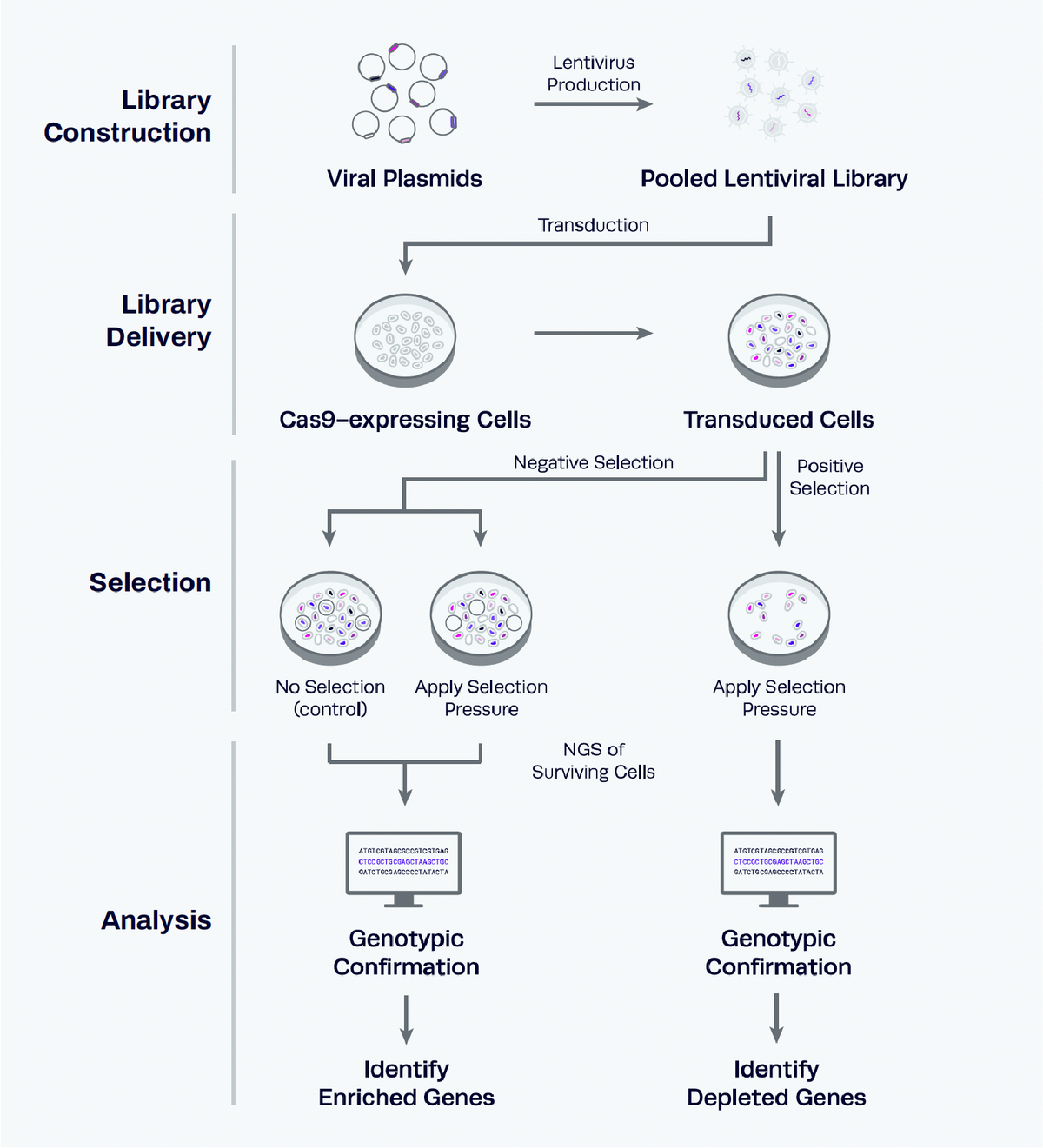
Performing a pooled screen can be divided into four main stages. The schematic highlights the main steps within each stage. Further details are provided in the descriptions of each stage below.
1. Constructing a pooled library
Plasmids encoding sgRNAs are sold as E.coli glycerol stocks. The plasmids are PCR-amplified and validated via NGS to ensure that equal representation is maintained. The plasmids are then packaged into lentiviral particles (one guide per vector) containing a selectable marker (e.g., antibiotic resistance gene). Typically, more than one sgRNA is designed per gene to increase confidence in genotype to phenotype correlations. Libraries can also be purchased as pre-packaged viral particles.
2. Delivering your pooled library into cells
The viral particles are then introduced into a group of cells at low multiplicity of infection (MOI) to ensure that, on average, only one viral particle will enter each cell and insert the gRNA sequence into the genome. MOI often needs to be optimized, adding too many viral particles per cell will result in cytotoxicity while adding too few will result in low transduction efficiency. Cas9 is expressed by using a Cas9-expressing cell line or through co-transduction. The population is then enriched for successfully-transduced cells (antibiotic selection) and subsequently expanded.
3. Selection for a positive/negative screen
A negative or positive selective pressure is then applied to select for the desired viability phenotype, or a biomarker is tagged and cells are sorted using fluorescence-activated cell sorting (FACS).
4. Analysis of results
The frequency of each sgRNA in the cell population is measured before and after selection. Because the sgRNAs integrate into the genome of the cells, they can be measured by next-generation sequencing (NGS). The enrichment or depletion of particular sgRNAs following selection relays information about the involvement of these genes in a particular phenotype and indicates targets that can be investigated further. Note that the identity and relative abundance of sgRNAs in the manipulated cell population, and not the edits made to the targeted genes, is the readout.
What is an Arrayed Screen?
Arrayed screens involve targeting one gene per well across a multiwell plate format. This format is a newer technology that is more versatile in both methodology and analysis than pooled screens. Library delivery may be accomplished through transfection or transduction. Because gene targets are separated across wells, phenotypes do not need to be selected for and sequencing/ data deconvolution is not required to associate phenotypes with genotypes. Arrayed screens are compatible with both binary and multiparametric assays.
Steps of an Arrayed Screen
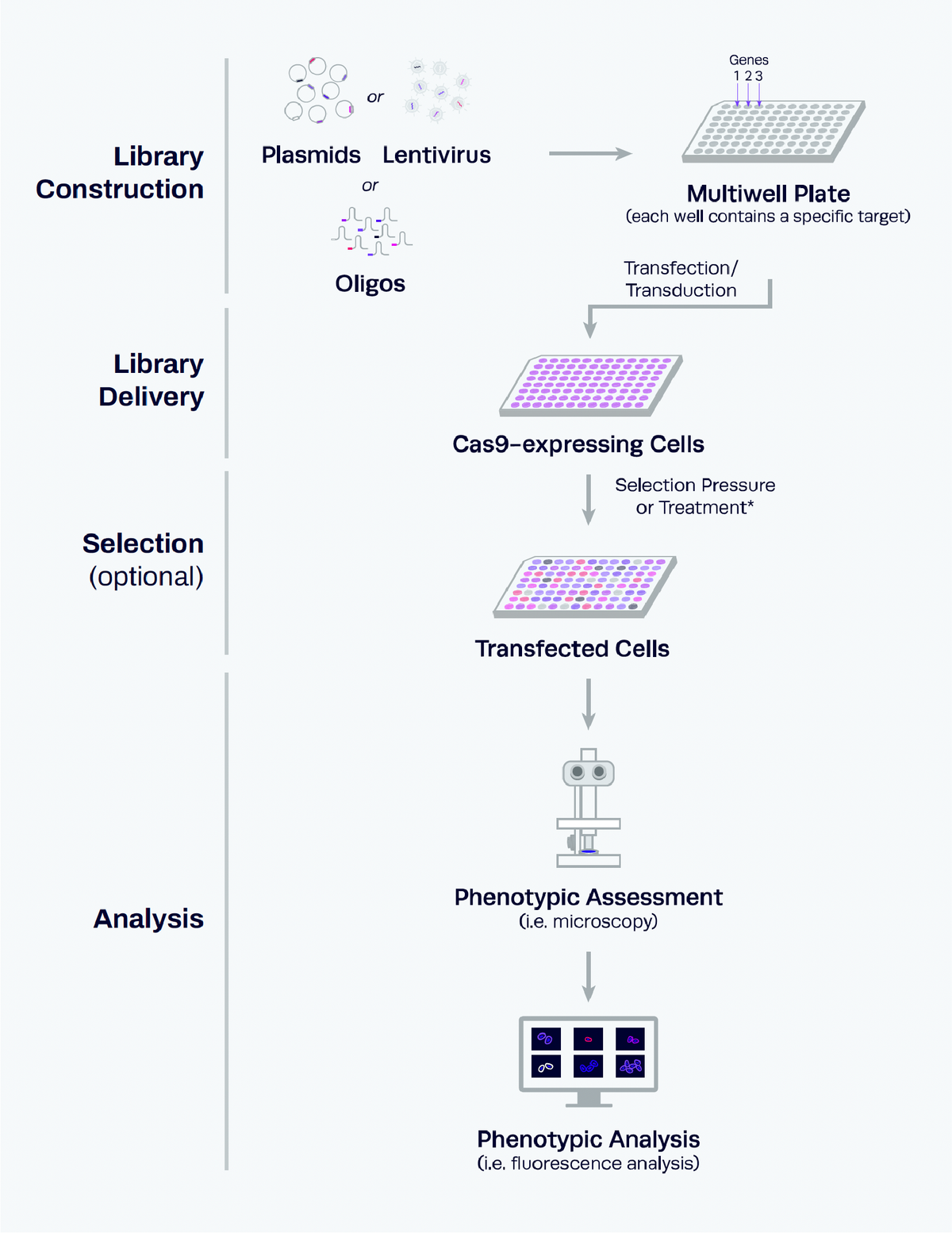
The majority of steps involved in an arrayed screen are very similar to those in a pooled screen, however differences in the specific details are due to the multiwell format and the distinct advantages that it offers. The schematic depicts the steps involved in performing an arrayed screen.
1. Constructing an arrayed library
Arrayed gRNA libraries can be produced in a variety of formats: plasmid, virus, and RNA oligonucleotides (synthetic sgRNA).
2. Constructing an arrayed library to cells
The gRNA is introduced to cells (one target per well) through one of a variety of methods. Cas9 is either co-transfected in plasmid format or in complexed ribonucleoprotein (RNP). Alternatively, Cas9-expressing cells may be used.
3. Applying a selection pressure is optional
A selective pressure, such as a drug, may be applied to arrayed screens in order to test what genes, when ablated, affect one or more cellular phenotypes when under certain contexts.
4. Analysis of arrayed screening results
Edited cells are assessed using an appropriate assay. Because each target is separated across wells, one can easily connect the phenotype to each genotype.
When to Use a Pooled or Arrayed Screen?
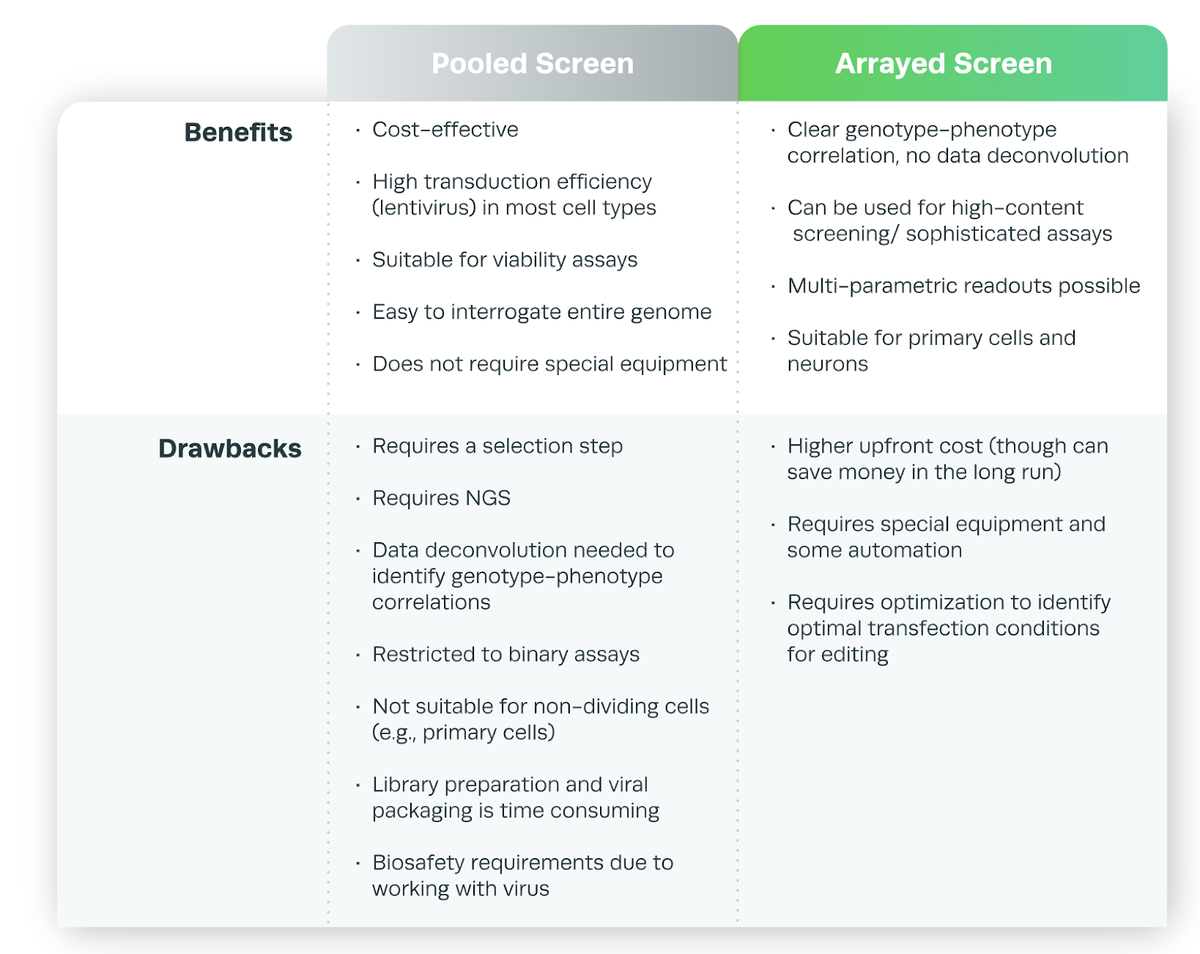
The decision on what screening format to use is based on a number of considerations, including the assay, cell model, and labor, among others. Below, we outline some of the advantages and disadvantages of each. A more comprehensive comparison of the benefits and drawbacks of each screen format is summarized in Table 1.
Assay compatibility is essential
As described above, pooled screens are restricted to binary assays, while arrayed screens are compatible with binary and multiparametric assays. Given these differences in versatility, it is important to think about what phenotype(s) would be most informative for answering your research question. For instance, if identifying genes that sensitize/desensitize a disease cell type to a given drug is the goal, then a pooled screen may be adequate. However, if the objective is to identify gene disruptions that cause changes in multiple morphological features or complex phenotypes, then an arrayed screen would be more appropriate.
Cell models can affect screening outcomes
The type of screen one chooses also depends on the cell model used. Because pooled screens require the integration of sgRNA into the genome and passage to daughter cells, they are most appropriate for use with actively-dividing cells. Pooled screens are thus not well-suited for primary cells and neurons, which have a limited capacity to proliferate. Alternatively, arrayed screens do not require an extended period of expansion and can be used with a variety of cell types.
Time and labor may vary between the two formats
The amount of time and labor associated with each screen workflow is often different. For pooled screens, plasmid preparation and viral packaging require considerable upfront work. Also, because cells with different gene knockouts are mixed together in pooled screens, complicated data deconvolution is necessary to untangle the genotype-phenotype relationships. Depending on the assay, analysis can be relatively straightforward for arrayed screens. However, for screens that use transfection (as opposed to transduction), optimization is required to ensure maximum editing efficiencies. This is especially true when working with synthetic gRNAs.
Having the right equipment for the job
Pooled and arrayed screens differ in the equipment required to conduct a screen. Whereas pooled screens can be conducted with standard laboratory equipment, arrayed screens often require automated plate handling capabilities to facilitate high-throughput transfection. In addition, a high-content system may be necessary to analyze image-based phenotypes.
Financial up-front costs are higher for arrayed screens
One of the main benefits of pooled screens is that they are relatively cost-effective to conduct. Thus, for simple assays, these screens offer a feasible way to interrogate the entire genome. Arrayed screens have a higher upfront cost, but because they can provide so much information, they can ultimately save money in the long run.
Thinking big picture: leveraging a combination of screening approaches
It is important to remember that pooled and arrayed screens can both be useful in screening workflows. For instance, if one aims to identify new drug targets, a pooled format may be appropriate as a primary screen to identify a broad set of target genes in an easy-to-transfect cell model (e.g., immortalized cell line). An arrayed format may then be used in a secondary screen to validate the hits using a more realistic model (e.g., primary cells). When designing a target identification experiment, consider all the tools at your disposal.
EditCo’s arrayed gRNA libraries include Whole Genome for Human and Mouse to maximize gene coverage across the genome, 30+ Pathway Libraries that include druggable, GPCRs, kinases, and immuno-oncology targets and User-defined Libraries so you can choose your specific gene set. All our libraries are designed with EditCo’s innovative guide design allowing efficient gene disruption through fragment deletions, ensuring more accurate and reliable results and compatible with a variety of high-throughput, automated systems.


