A field report from the EditCo team
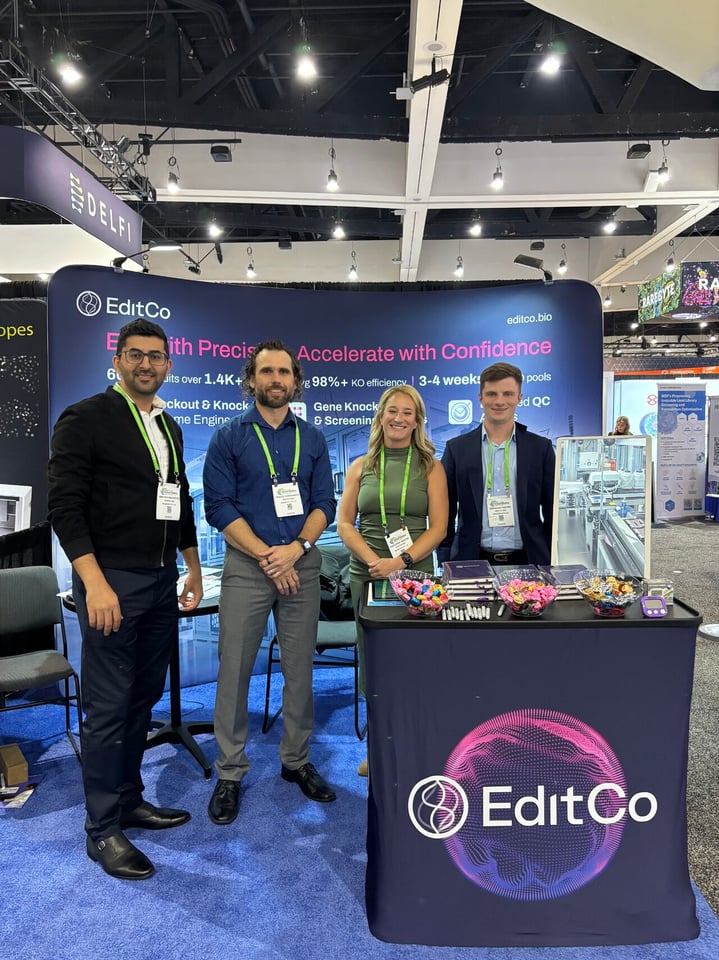
At booth #1617 on the AACR exhibit floor, the atmosphere was familiar for anyone in cell engineering. Scientists walked by with conference bags and unfinished coffees, all asking the same question: Can you get me the cell line I need, on time, with edits I can trust, without having to re-validate everything?
This question has always been central to the meeting. The 2026 AACR Annual Meeting, held April 17 to 22 at the San Diego Convention Center, brought together more than 21,000 attendees under the theme Precision, Partnership, Purpose: Advancing Cancer Science to Save Lives Globally. What’s changed is the speed of discovery, the complexity of the constructs, and how crucial it is to get things right.
Our EditCo team came from Redwood City with our booth and a full schedule of conversations. We left with even more to consider. Here are five key takeaways from the meeting that every research tools team should pay attention to now. Each story is clinical or translational on the surface, but at the core, they all show that engineered cells are now the main bottleneck in oncology research, and the demands are changing fast.
If you couldn’t make it to San Diego, here’s a quick summary.
1. CAR-T's solid-tumor turn is going to change what T-cell researchers ask for
For over a decade, CAR-T has been the big story in cancer immunotherapy, but always with a catch: it worked well in liquid tumors but hit a wall in solid ones. This year, that catch got much smaller.
Janos Tanyi from Penn Medicine shared the first clinical data from the STAR-101 Phase 1 trial of KIR-CAR, a multi-chain CAR T construct based on natural killer cell-like receptors instead of the usual T-cell receptor design. This change aims to avoid T-cell exhaustion, which has limited CAR-T’s success in solid tumors. Early results in ovarian cancer, mesothelioma, and cholangiocarcinoma were strong, even at low doses and with limited toxicity, so the field now sees this as real progress, not just another exception.
In his Opening Plenary, Carl June discussed the major changes happening as CAR-T evolves for solid cancers. Saar Gill from Penn spoke at the AACR-ASCO joint session about in vivo CAR-T, which means making engineered T-cells within the patient rather than outside. If this approach can be scaled, it could lower costs and speed up turnaround times. For liquid tumors, Omar Nadeem from Dana-Farber led the CAR-PRISM trial, using BCMA-directed CAR-T in smoldering myeloma, a precursor condition. All 20 patients in the trial reached MRD negativity within two months after just one infusion.
What does this mean for research tools? These constructs rely on advanced T-cell engineering, like multi-receptor designs, multiplexed knockouts to manage persistence and exhaustion, and knock-ins at safe-harbor sites for reliable expression. The preclinical work behind them, such as screens, candidate validation, and resistance mapping, needs primary T-cell models at a scale and consistency that off-the-shelf reagents often can’t deliver. That’s why we created our knockout CD4+ and CD8+ T-cell pools. The main bottleneck for next-generation cell therapy isn’t the construct design, but the cells you use to test it.
2.The RAS arms race is about to remake the model-system landscape
One of the biggest drug stories at AACR 2026 was Revolution Medicines' daraxonrasib. This pan-RAS(ON) inhibitor showed Phase 3 results in previously treated metastatic pancreatic cancer, with a 60% reduction in risk of death. In a disease where five-year survival is usually around 12%, that’s a major breakthrough.
At the meeting, RevMed shared updated Phase 1/2 first-line data: a 47% objective response rate as a single treatment in 38 previously untreated metastatic PDAC patients, which rose to 58% when combined with gemcitabine and nab-paclitaxel. They also introduced RM-055, a next-generation mutant-targeted catalytic RAS(ON) inhibitor designed to switch mutant RAS back to its inactive state. This helps overcome resistance to earlier RAS inhibitors in preclinical models.
The broader ecosystem had even more news. At least four companies at AACR introduced pan-RAS antibody-drug conjugates, combining pan-RAS inhibition with ADC designs to improve tumor selectivity and reduce the systemic toxicity that has been a major challenge. The so-called "undruggable" cancer target of the last thirty years is now creating a whole new competitive subspecialty in just one conference cycle.
What does this mean for research tools? Resistance is the next big challenge, and solving it comes down to model systems. Labs need to build isogenic cell line panels that include every clinically relevant KRAS, NRAS, and HRAS variant, like G12D, G12C, G12V, G12R, Q61H, and many less common mutations, with precise edits and preserved downstream biology. This will separate the labs that publish first from those that follow. The same applies to combination treatments: when daraxonrasib is paired with elraglusib, checkpoint inhibitors, or degraders, the model systems must reflect the combined biology, not just the individual parts. The demand for variant cell lines will need to grow quickly, and statements like, "I need this exact edit, in this exact background, by next month" is only going up.
3.AI got its own plenary, and the bottleneck just shifted upstream
The third Plenary Session, called AI Revolution in Cancer Research, was described by chair Jakob Kather as the highlight of the meeting. What stood out was not excitement, but a more careful and thoughtful tone. Suchi Saria explained that using AI in real clinical settings requires rigor that matches the stakes, and trust comes from validation, not just demonstrations. Regina Barzilay also shared her work on AI for therapeutic discovery and risk assessment.
This topic came up throughout the meeting, not just in the plenary. Penn hosted a session on AI-powered tissue maps that combine spatial omics and pathology imaging, showing where multi-modal cancer data is heading. On the last day, the Advances in Technologies session even asked if AI could one day act as the oncologist.
What does this mean for research tools? We keep coming back to this topic. AI-driven target discovery is generating prioritized hypothesis lists faster than experimental biology has ever seen. The bottleneck is no longer finding candidate targets with computation. Now, it’s about functionally validating these candidates in the right cell context, quickly enough that the next model update doesn’t leave us behind. This challenge is really about CRISPR throughput and cell engineering. The labs that will lead in AI-target validation over the next eighteen months are those that have already streamlined their upstream cell biology by using arrayed knockout pools, endogenous tags for live-cell readouts, and isogenic backgrounds that don’t need months of quality control. Discovery is becoming automated, and validation needs to keep up. This is a challenge for the whole RUO ecosystem, not just one vendor.
4.Cancer interception got promoted, and early biology needs better models
AACR has traditionally focused on treatment, but that has changed. This year’s Presidential Select Symposium was about precision-based prevention. Major sessions covered topics like aneuploidy and mutations in normal tissues and their role in cancer initiation, cancer prevention and screening, and a late-breaking minisymposium on the genomic landscape of likely human precancers. The Discovery Science Plenary on Saturday, called The Next Frontier in Minimal Residual Disease: Solid Tumors and chaired by Stanford's Maximilian Diehn, drew a full audience for good reason.
For a community that has spent forty years improving late-stage therapy, this is a big shift. The main idea: catching disease earlier, or stopping it before it starts, is a more effective strategy than just treating advanced cancer better. The CAR-PRISM data in smoldering myeloma shows this change, as does the focus on MRD detection in solid tumors.
What does this mean for research tools? Interception biology needs a clear understanding of what normal and premalignant cells look like, and the molecular changes between them, in cell types that truly represent the tissue of origin. This is a model-system challenge at every level. iPSC-derived lineages with isogenic disease alleles, endogenous reporters that let you watch state transitions live without overexpression artifacts, and primary cells edited cleanly enough that the phenotype you see is the biology, not the editing. This is where our partnership with Promega, bringing HiBiT, HaloTag, and NanoLuc tagging into our CRISPR knock-in service, is making the biggest impact in customer conversations right now. Most of the precancer mapping at AACR was descriptive: sequencing what’s there. The next step is mechanistic, and in 2026, that means precise editing in physiologically relevant cells with quantitative readouts.
5.The RUO ecosystem is converging on "cells as reagents," and we're not the only ones noticing
If you walked the exhibit hall this year, you saw the convergence happening right in front of you. REPROCELL showed StemEdit and new clinical iPSC lines using AI-designed editing systems. iPSC platform companies like Axol Bioscience and Cellistic are expanding their disease model catalogs. Promega is focusing more on protein-tagging chemistries that work with CRISPR knock-ins. AI-designed editor companies are starting to add new enzymes to the same workflows we’ve all been using with Cas9 and Cas12.
The big takeaway is that the field is moving away from labs growing and validating cells from scratch, and toward ordering cells as reagents with guaranteed edits and fast turnaround times. That’s the idea EditCo was founded on when we spun out of Synthego in 2024. It’s why our whole product line, from XDel knockout cells to T-cell knockout pools to HiBiT-tagged knock-ins, is built for predictability and guaranteed editing outcomes, not just custom projects. Walking through the exhibit hall this year showed that the whole RUO industry is heading in the same direction. The big question now is how quickly we can make these reagents truly on-demand, at the quality level that downstream therapeutic and discovery work needs.
What we're taking back to Redwood City
We’re taking away three main things. First, the cell therapy boom in solid tumors is real, and T-cell engineering is getting more complex, so the need for multiplexed primary cell models is rising too. Second, the RAS wave is about to change what every preclinical oncology lab needs in their isogenic variant catalog, and labs with variant lines already on hand will move faster than those still designing guides. Third, the flood of AI-generated hypotheses is here, and functional validation is now the main bottleneck, which is exactly what our industry is built to solve.
If any of this matches the work you’re doing, whether it’s CAR-T preclinical screens, RAS-mutant model panels, AI-target validation pipelines, or interception biology in iPSC-derived systems, we’d really like to hear from you. Some of our best booth conversations this year started with a scientist describing a problem, and us realizing we had a product, partnership, or custom workflow that could help.
Explore our engineered cell models or reach out to start a conversation.
See you next year.
— The EditCo team